Can the California Buckeye be the mother of plants in a drying state?
By Etta Stewart and Ryan Suchomel
Can the California Buckeye be the mother of plants in a drying state?
By Etta Stewart and Ryan Suchomel
Contact: ebstewart@csuchico.edu and rwsuchomel@csuchico.edu
What does drought in California actually look like? We hear charged language like “desertification” all the time, so what is happening to our land? And what are scientists doing to prevent our state from becoming an enormous desert?

Desertification is a well observed phenomenon that describes the gradual shift in the climate of any plot of land from a productive ecosystem of plants, soil, and animals, towards a dry, barren desert where living things seldom survive. These kinds of changes are most prominently noticed in agriculture fields where people have not practiced sustainable land management. Things like overgrazing by livestock, lack of crop rotation, and misuse of water resources all contribute to desertification. Since California is one of the world’s leading exporters of produce with most of the land in the central valley being dedicated to agriculture, desertification risks are important for growers and scientists to assess and mitigate.
One of the ways we can help our land retain productivity (the rate at which living things like plants grow) and diversity (the number of different species living in an area) is through nurse plants. Nurse plants act as shields in tough environments such as the brutal California summers, providing shade and other favorable conditions for plants to grow in. We define these conditions provided by the nurse plants as the “soil microclimate.”

Many native plants in California not only survive the harsh conditions of the state’s climate, but they thrive in it. We decided to look at the microclimates underneath California Buckeye, a short tree with broad leaves that grows in canyon walls and along streams and rivers. Since the Buckeye is such a well-adapted plant to the climates most at risk for desertification, we hypothesized that it might have a nursing effect on the plants growing underneath it. Comparing the microclimates of Buckeyes with the trees nearest to them gives us an indication of how well the Buckeye performs as a nurse plant in its natural environments. This allows us to make an informed decision on the Buckeye as a “model organism” for mitigating desertification in mediterranean climates like Northern California.
Butte county is littered with streams, but as an agricultural community with cities and industry the streams are used very differently. Lower Bidwell Park is a city park that borders Big Chico Creek in the downtown of the city of Chico. Table Mountain Ecological Reserve is known for its wildflowers but is also home to over a dozen waterfalls and seasonally flowing creeks. The Reserve holds a profile of native species, untouched by urban development and only approached by weekend hikers. We wanted our study to be applicable to a range of locations, no matter how busy or pristine.
We picked 3 buckeye trees at Lower Bidwell Park (a site upset by human activities and local pollutants) and 3 at the Ecological Reserve (a site that is well protected from these disturbances) to sample for their “nursing” effect. To compare buckeye as a particularly generous plant, we also selected the nearest non-buckeye tree and sampled it the same way.
We sampled the conditions that these trees provided as well as the way that the vegetation underneath responded to the buckeyes’ help. We measured soil moisture, pH, depth of the blanket of dead leaves on the ground, how high the lowest branch was and the distance from the creek that the trees were growing around. We also used a rounded mirror called a densiometer to measure how much the tree leaves blocked out the sun which has an effect on keeping the microclimate cool but also can limit the amount of energy the plants under the canopy have access to. There was a big difference in canopy cover between the two types of trees with buckeyes having 83.3% canopy cover and the nearest trees having 62.4% canopy cover.

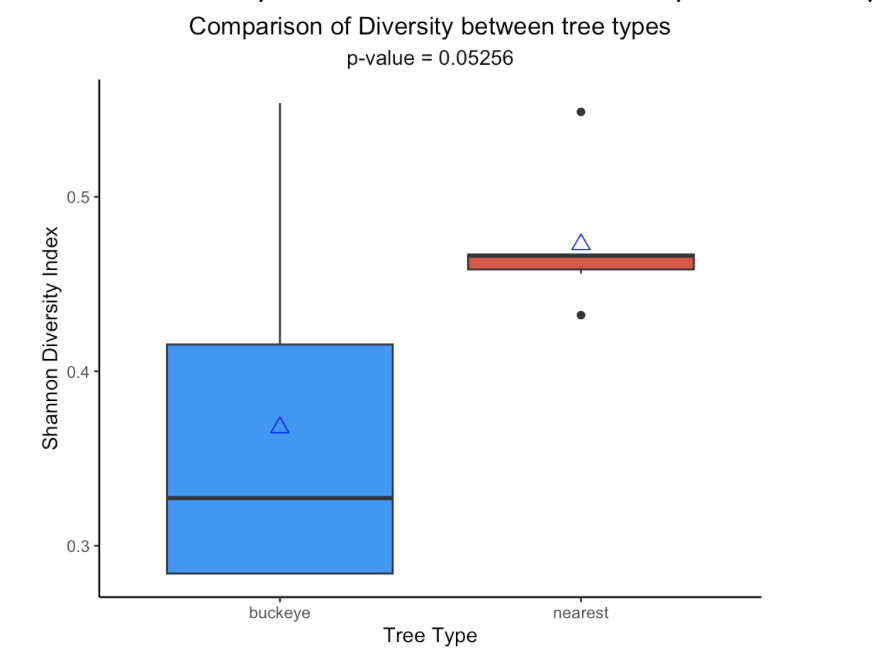
Next, we used a method called “point intercept” sampling to see who lived in these microclimates. There was diversity abound in these areas with different types of grasses, spring flowering forbs, shrubs, water loving sedges and tangled vines. We surveyed the percentage of the ground that is covered by each category to see the relative abundance and diversity of plant life underneath these trees.
From our measurements of diversity, we found that the nearest trees actually had a higher mean diversity (the triangle on our graph) relative to the Buckeye. The Buckeyes also had a much wider range of diversities in the sites that we sampled. This appears to indicate that the Buckeye might provide a less welcoming habitat for other species. This might be due to several factors specific to the Buckeye, such as its higher canopy cover or even allelopathic properties (a defense strategy where plants send toxins into the soil around them). However, it’s important to note that our sample size for our trees was very limited, as well as our ability to accurately ID plants.

Student-Led Survey of Big Chico Creek Riparian Zone at Chico State
By Kaitlyn Walsh and Megan Ambriz
Student-Led Survey of Big Chico Creek Riparian Zone at Chico State
Kaitlyn Walsh (kmwalsh1@csuchico.edu) and Megan Ambriz (meambriz@csuchico.edu)
Chico Creek is a beautiful part of the Chico State campus and is an essential native riparian habitat to many native plant and animal species. Over the years, there have been numerous conservation efforts in order to preserve and improve the habitat by removing invasive species and replanting native species. We are taking a closer look at how effective these efforts have been and how much the habitat has changed over the years.

A survey previously conducted by Sabrina Nielsen and Adrienne Edwards assessed the condition of Big Chico Creek and classified the invasive risk of vegetation on multiple sites along the creek. Using their data, we were able to analyze the spread of invasive and native plant species along their previously analyzed area and reassess invasive risk and spread. What we found was promising! We found that more native species were present and had even migrated into the area since the previous research project was conducted. This suggests that restoration efforts implemented previously have been effective and are helping to create a healthier and balanced habitat that will allow native species to flourish and let future generations of students enjoy the natural beauty that Chico State’s campus has to offer. This project has allowed us to develop valuable data to help support conservation and restoration strategies that can help impact future efforts and enhance our ecological understanding of Chico Creek.
We hope future students will take a similar interest in the well-being of our creek and continue to lay the foundation to help improve our campus community. Even with the successes of previous restoration projects, riparian habitats like Chico Creek are constantly changing and need continuous monitoring and evaluation to create lasting change. Organizations on campus, such as Green Campus, are always looking for volunteers to help with invasive species removal and re-planting. Whether you're passionate about conservation or just love the beautiful scenery of our campus, there’s a way to get involved and help!

Analysis of Water Properties Upstream to Downstream of Big Chico Creek
By Olivia Lane and Paula Toledo
Analysis of Water Properties Upstream to Downstream of Big Chico Creek
By Olivia Lane and Paula Toledo
Contact: oblane@csuchico.edu ptoledoortega@csuchico.edu
California State University, Chico students Olivia Lane and Paula Toledo conducted a spring semester-long experiment in their Field Ecology course, BIOL 484W. This Project consisted of analyzing the water quality upstream, midstream, and downstream to determine any variations in chemical concentrations and water flow properties. The 3 different sites used in the experiment are along Big Chico Creek, which originates from Colby Mountain, spans about 45 miles and its the largest river in Butte County. They investigated the physical and chemical properties across the downstream, midstream, and upstream regions. We were also in collaboration with another group to see how water properties in these same areas affect the macroinvertebrates in each area. Our locations involve our midstream area on Chico State campus, Big Chico Creek access on River Rd as our downstream, and Upper Bidwell as our upstream location.

Our main question was “ How does upstream, midstream, and downstream change the water properties within Big Chico Creek?” We hypothesized that upstream water properties exhibit more favorable conditions, characterized by lower concentration of chemicals ( nitrate, nitrite, pH) and higher levels of dissolved oxygen.
Using a freshwater testing kit, we tested for properties such as nitrate, nitrate, and pH levels in the water. As well as using a water thermometer to test temperature and a DO meter to test for the presence of dissolved oxygen in the water.

Right wearing green: Paula Toledo, Left wearing Black: Olivia Lane
Upper Bidwell ( Upstream) Location
After three weeks of gathering data and anazlying, We expected the water properties downstream would contain higher concentrations of chemical properties, lower dissolved oxygen levels, and reduced pH compared to upstream water properties which were expected to contain more favorable results because it was less affected by pollution from external sources.


By observing the table results, they concluded, the River Rd. ( downstream) location did have slightly higher or more equal concentrations of the tested chemicals ( Nitrite, Nitrate, pH). For week 2 table, downstream had lower dissolved oxygen levels compared to upstream and midstream while maintaining a slightly lower pH level. By observing the results, the data slighty rejects the null hypothesis that downstream will contain higher tested chemical concentrations, lower dissolved oxygen levels, and reduced pH.

PC1 demonstrates the relationship to DO levels and PC2 is pH. From the data it was noticeable that there was a relationship of temperature affecting Do and pH levels. Their midstream and upstream locations were heavily affected by the DO levels at our sites and downstream was more affected by pH.
A World of Water: How Aquatic Life Plays a Role in Determining Stream Health
By Jason Ellis and Jordan Kruger
A World of Water: How Aquatic Life Plays a Role in Determining Stream Health
Jason Ellis - jcellis@csuchico.edu & Jordan Kruger- jkruger2@csuchico.edu
In today’s world, the impact of humans can be seen everywhere. From areas that are heavily influenced by anthropogenic activities, to those that are more untouched. The streams that run through our lands are a great way of telling the general health of the ecosystem around them.
In our study, we focus on Big Chico Creek. It starts up in the mountainous headwaters of the Sierra Nevadas, and runs through Upper Bidwell Park before making its way into the city of Chico. This makes it an ideal stream for a study of water quality due to it going through different conditions. These conditions cause a variety of differences such as water temperature, dissolved oxygen, pollution, human impacts and much more.
Benthic macroinvertebrates are a great indicator of water quality. This is because such a variety of insects, worms, snails, crustaceans, mites and other stream dwelling creatures have such a different tolerance for water conditions. Some can live happily in streams filled with trash and a variety of human-caused runoff that negatively affects the stream. Others can only live in streams with little to no pollution. They disappear from these systems once a source of pollution develops. We used this tolerance to our advantage by sampling at two different locations on Big Chico Creek to get an idea of what is able to live in each location. The two locations chosen for this study are Upper Bidwell Park at Day Camp before the stream flows into Chico, and at a higher elevation at highway 32 in Deer Creek Canyon.
The water conditions were noticeably different with the Deer Creek Canyon having a more narrow stream, faster flow, and larger rocks/boulders. Upper Bidwell Park had a wider stream with slower flow, and smaller particulate matter. Using a D-shaped dip net to collect benthic macroinvertebrates we collected aquatic specimens from both sites and preserved them in ethanol to bring them back to the lab for analysis.
After using microscopes to identify each macroinvertebrate to a family level identification we had an idea of what differences there were between the two sites. Initially, the first thing we noticed was how much more abundant the Deer Creek Canyon location was compared to the Upper Bidwell Park location which had a significantly lower amount of specimens. Not only this, but the highway 32 location had a higher diversity of samples and individual macroinvertebrates which have a low tolerance for pollution and disturbance. These sensitive indicator species were notably absent from the Upper Bidwell Park location.

Site 1 on the left, located at Upper Park, presented a slower moving stream with lots of fine sand and a more open scheme. Site 2 on the right, located at the highway 32 crossing, contained higher quantities of boulders, swift shallow waters and little to no sand present.

This is a map of the two sights we collected from. It can be seen that the upper sight is quite different than the lower sight. There are drastic changes in elevation and topography as the creek reaches the valley, running through the city of Chico before reaching the Sacramento River.
As a result of this comparison of the two sights we found a slight difference in some groups of organisms such as mayflies at the family level with a greater difference at the family level in stoneflies and caddisflies. The group known as true flies or Diptera were fairly similar as well as the types of watermites and aquatic beetles present among both sights. Sight 2 did have greater diversity at the generic level with three species of the genus Drunella alone. Some of these differences were due to changes in elevation, however comparisons of the two communities suggests that the lower sight, sight 1, has some level of human-caused degradation that is affecting the stream’s health in that portion of Big Chico Creek.
The Effect of Channelization on Factors of Habitat Quality in Big Chico Creek
By Robert Banta-Green and Grace Birdwell
The Effect of Channelization on Factors of Habitat Quality in Big Chico Creek
Bobby and Gracie
gbirdwell@csuchico.edu
rbbanta-green@csuchico.edu

Channelization of streams has become a trend in cities and agricultural areas where human involvement is altering the landscape, and therefore the quality of the habitats it provides. The artificial narrowing of stream channels can have impacts on the sediment distribution, available oxygen, and acidity of the water. Organisms relying on these habitats can be sensitive to changes in these factors, which is why it’s important to understand how human interaction can have an impact.
Channelization can include narrowing, straightening, and embanking streams in order to control the behavior of rivers and streams for the benefit of humans. Cities may channelize streams as they see fit for the convenience and benefit of those living there. While there are benefits for humans, the altering of streams and rivers can have major impacts on the health and status of wildlife. This is crucial to consider as certain species rely heavily on their specific environment. Shifts in dissolved oxygen, acidity, and sediment distribution can affect how animals find food, interact with predators and/or prey, and more. Changing these things has been shown to have detrimental impacts on some species that if lost, may cause much more grief for humans than we realize. In fact, certain species are already endangered. Many stream and river fish, like salmon and trout, are very economically important to the fishing industry. Once they are lost, those species can never be recreated and we have lost that resource forever. As these trends continue, it could lead to the losses both on a greater economic level and individual level for the many that rely on fishing for their livelihoods.

Aquatic animal species require certain levels of available oxygen to stay healthy long enough to reproduce. Too much oxygen can allow for harmful algae to bloom and kill endangered fish. While an environment that lacks oxygen makes survival an impossibility. Different animals require different amounts of oxygen. Fish require an highly oxygenated environment compared to other aquatic animal and plant species, making them especially sensitive to environmental change. Oxygen availability is not the only determinant of aquatic habitat health. Human behavior has also increased aquatic acidity, which has a dramatic effect on the health of important fish species such as trout and salmon.
Aquatic acidity change is one of the greatest threats to commercial and endangered fish species such as trout and salmon. An increase in acidity hurts these important and endangered fish at all stages of their life. An increase in acidity decreases the survival rate of eggs and young fish. This leads to a significant population decrease over time. An increase in aquatic acidity also kills many of the aquatic insects that commercial and endangered fish species rely on for food. Changes in aquatic acidity overtime lead to a decrease in the survival of commercial fish at all levels of their development, leading to hardship for people and economies that rely on these endangered species to survive. Channelization also has an effect on the health creek bed habitat.

Aquatic animals, especially shellfish and young trout and salmon, require a diversity of stream bed habitat to move up and down stream and reproduce. Channelization increases water velocity, in turn washing larger sediments such as cobble and boulders downstream, which animals use as spawning grounds and resting areas. Fish require larger sediment types to protect them as they fight the current to reach their spawning grounds. A decrease in available protective habitat can lead fish to run out of energy and die before they are able to reproduce. And a lack of proper sediment diversity leads to trout and salmon eggs being washed downstream and consumed before they can hatch. We used these environmental factors to assess the current habitat health of a channelized urban creek in rural California.
To further understand the effects of human impact, we decided to investigate how channelization affects the habitat quality of Big Chico Creek in Chico, CA. Over the course of several days we measured dissolved oxygen levels, pH levels, and sediment distribution of the creek. Collecting this data for sites upstream and downstream from the channel, as well as within the channel allowed us to assess the impact of this structure on the creek. We found that the channel does cause a shift in the important aspects of stream health detailed above. Therefore, the channelization of Big Chico Creek makes it a lower quality habitat for aquatic species. This is important to recognize because the valuable biodiversity of Northern California relies on delicate habitats like this, which can be changed so greatly by human interference.
Insect and Diatom Richness Distribution in Big Chico Creek
By Ethan Poggi and Diego Reyna-Wood
Insect and Diatom Richness Distribution in Big Chico Creek
Ethan Poggi and Diego Reyna-Wood

Big Chico Creek is an urban stream that runs through the city of Chico as well as California State University Chico. Urban streams are known to have high nutrient and contaminant concentrations, and altered channel morphology and biodiversity. Our project focused on sampling aquatic insects and algae(diatoms) to assess stream health and water quality in different parts of Big Chico Creek on Chico State campus, as aquatic insects and algae can be used as biomarkers for stream conditions.
In order to collect data for this study, various sampling methods were used. We first established 4 transects along Big Chico Creek and chose a sampling site in the middle of each one. At each sampling site, to collect insect data, we performed 1 kick net sample at 3 wetted widths (25%, 50%, 75%) using a D-net of 1ft2 of stream bottom. Diatom collection was also fairly simple. At each sampling site, we used a toothbrush to scrape all the algae off 3 rocks, 1 for each wetted width (25%, 50%, 75%).
In total we collected 6 orders and 12 families of aquatic insects from our 4 transects and we collected 6 morphologies of diatoms. Depending on where we sampled insects and diatoms, we saw extremely different results.

Figure 1 and Figure 2 show insect and diatom richness and how it varies for each transect sampled.
Transect 1: This transect had the lowest species richness for both diatoms and insects. This makes sense considering that this transect had the fastest moving water and was the most channelized part of the creek.
Transect 2: Insect richness was the highest in this part of the creek, while diatom richness was second highest. This indicates that conditions were the best for insect species while not being the most ideal for diatoms. This part of the stream did seem to have more of a mix of sand and large rocks making up the streambed compared to the other transects. This may imply that these are more effective sampling conditions and possibly better habitats for aquatic insects.
Transect 3: This transect had the most similar measurements of species richness. At this site, the depth of the water varied from ankle deep at one end and waist deep at the other. The streambed consisted of baseball- sized rocks and sand. The diversity data we collected may help indicate that these types of stream conditions were optimal for both species.
Transect 4: Diatom richness was highest in this part of the stream. The water was moving fairly fast, but stayed relatively shallow (ankle deep) on both sides of the creek. Our data may support the idea that this is the most optimal site for diatoms in the creek.
Overall, the individual distribution of diatom and aquatic insect richness that we collected has helped map the physical conditions of the stream by indicating the most and least optimal physical conditions for each species. In the future we would like to test the chemical conditions of the water, in order to see whether or not they correlate with diatom and aquatic insect richness.
Diatoms, More Than Meets The Eye
By Dannika Delay and Emily Huerta
Diatoms, More Than Meets The Eye
Dannika Delay and Emily Huerta (dday2@csuchico.edu, ehuerta10@csuchico.edu)
When you look at a stream or any body of water, what do you see? Likely you will see water, plants, rocks, and if you’re lucky maybe you’ll see a fish or two. However, the world within that stream has many moving parts, each just as important as the next. Located on the rocks and other pieces of debris inside the stream is home to millions and billions of microscopic organisms called diatoms. Diatoms are algae that live within houses made of glass. These houses can be a variety of shapes and sizes and can even be arranged by artists to make a geometric work of art. However, diatoms aren’t just pretty to look at. They are vital parts of the ecosystem, and they can tell us a lot about the health of the stream they live in. Diatoms are one of the major primary producers on Earth, responsible annually for about 20% of photosynthetically fixed CO2 on the planet. Diatoms are also very sensitive to the environment within the water, if the water becomes too warm, cold, acidic, etc., individuals begin to die out. That is what the goal of our project was, to see how different stream conditions can impact diatom diversity.

For our project, an important part is choosing which streams to sample in the Butte and Yuba County area within Northern California. We had to consider stream condition, land use, and accessibility. We selected three streams and assigned them a land use to identify them by. Big Chico Creek is our urban stream, Comanche Creek is our natural stream, and our agricultural stream we refer to as Ag stream. We collected two samples per site. To obtain these samples we wadded into the stream and randomly grabbed a rock, scrubbed the entire surface of it and collected the runoff of water and algae. We repeated this process twice per site collecting two vials per stream. Additionally, we measured stream temperature and dissolved oxygen. This took place over one day in the field. Then we took our samples back to the lab and spent several hours examining them under a microscope to identify diatom morphology.
So, what is the importance of diatom morphology? There are many groups of diatoms, but the ones we observed from our samples include Araphid, Symmetric and Asymmetric Biraphids, Monoraphids, Epithemioids, and Nitzschioid. The morphology is critical to consider the diatom's ecological role in its environment. It can influence resource uptake, sunlight sensitivity, carbon fixation, and predation. All of these functions are important in aquatic ecosystems and the lack of one can tell us about the health of the stream. The more diverse diatom communities present, the more these biological processes can be performed.


The results of the experiment found that diatoms had the most abundant morphological diversity within the natural stream, followed by the urban stream, and lastly the agricultural stream. In addition to having the most diversity, the natural stream had the highest levels of dissolved oxygen. The urban stream had lower diversity and dissolved oxygen levels. What was particularly surprising was the Ag stream. Not only was there only one diatom found in the sample, but it was also torn up and mangled, making it impossible to see the morphology. The slides that were looked under the microscope also were inhabited by debris, no doubt giving us a hint about the health of the stream.
Now when you look at a body of water, there is more to consider. Small but mighty, the diatom is an indicator of stream health and necessary for many biological functions. Our effect on them through land use can harm their diversity and ability to carry out important functions, like photosynthesis. This in turn can negatively impact the living things we can see, like fish and other species that live in or near the water. If you enjoy the beauty of nature and aquatic ecosystems, keep diatoms in mind when making environmentally conscious decisions.

Insect Survey of Permanent and Seasonal Streams
By Blaine Robbins and Connor Lydon
Insect Survey of Permanent and Seasonal Streams
By:
Blaine Robbins
bmrobbins@csuchico.edu
Connor Lydon
Cjlydon@csuchico.edu

Blaine Robbins using a dip net in Mud Creek
You may think that bugs are disgusting or creepy, but they are hugely important little critters for many reasons. They are crucial to the environment and can tell us a lot about the health of an ecosystem and water quality. Pollution, contamination, and excessive siphoning are major contributors to poor water quality and its effect on aquatic ecosystems. A good and clear indicator of water quality is the presence ,or lack thereof, of aquatic insects. Many aquatic insects are sensitive to pollution and contamination and may indicate the health of a stream or river especially in an agricultural area. This can directly tell us the quality of water that is being used for agriculture and crops in the immediate area, which could possibly be a health concern. The variety of insects found is the important aspect, as some insects may be more sensitive than others. It’s also important to note that this study took place following the wet season, in a stream that flows all year round compared to a stream that would dry up during the dry season. This could potentially tell us how a dry year could drastically affect aquatic ecosystems and the water quality in the general area. In addition, we can infer that species found in the seasonal stream are better colonizers due to the significant shift in habitat from dry creek bed to wet creek.

Stony Creek, 2 miles south of Hamilton City, Ca
The diversity of insects in the streams is a direct result of how we treat our water, in the upper streams of the Sierra Nevada Mountains where humans have little to no impact the stream health is immaculate. With near perfect biodiversity, no pollution, and no water being siphoned off to feed cities the diversity of insects is immaculate and near untouched. At the base of the foothills in the California Central Valley, we surveyed two streams. Stony Creek is a permanent stream fed by the Black Butte Dam on the west side of the valley, and the other is Mud Creek which dries up in the summer due to lack of water supply and over use. We got in the water and surveyed the insects and other life we could find on the bottom of the creeks in Late March of 2025. In our nets we caught 400 organisms which we brought back to our lab to identify and categorize them. From this we were able to use these insects to help us better understand the differences or lack of differences between the permanent and seasonal streams. In our samples we noticed a significant amount of one specific Order of insects, the Ephemeroptera or commonly known as Mayflies. This order of insects we broke down into 4 families to compare the two streams and we found that there was a significant difference in the presence of the families in the streams. We were unable to determine why there would be a difference in the two streams that would lead to such a significant difference in Mayfly proportions.

Mud Creek, 5 miles east of Hamilton City, Ca
Aquatic insects, mainly the mayfly, are an important food source for many animals including birds, frogs, and fish. In California’s efforts in bringing back and restoring the salmon population, mayflies are a huge part of their diet. Many young salmonids feed off mayflies, which were a common find in our study. The presence of mayflies is important not only for the health of an aquatic ecosystem but also to provide a key food source to a species that California is putting in a lot of effort to restore. Unfortunately, we were not able to come to a conclusion as to why we found the results we did, however, future research into bringing Salmon and other fish back to the streams of the Sierra Nevada foothills would benefit from more research on these insect populations.

B. Robbins and C. Lydon in Stony Creek collecting insects
Vinca Major outcompeting native plant species along the Big Chico Creek
By Sajan Willbanks and Azreal Sanchez
Vinca Major outcompeting native plant species along the Big Chico Creek
Authors: Sajan Willbanks, Azreal Sanchez
Contact information: spwillbanks@csuchico.edu, adsanchez1@csuchico.edu
Almost anywhere you are with abundant vegetation, a large portion of plant species will be invasive to the area. It is no different along the Big Chico Creek that runs through California State University, Chico. One particular species, Vinca major, seems very prevalent along the creek, especially under tall, shade providing trees. The goal of our project is to determine the correlation between abundance and competitiveness of Greater Periwinkle, Vinca major, with native plant species and if they are outcompeting the native plant species.
Although Greater Periwinkle is a beautiful trailing vine that many establishments utilize to create an aesthetically pleasing landscape, it is a highly invasive plant species to California. Vinca major is a spreading perennial groundcover originally from Europe and Africa which means that this plant species survives year round. Not only is Greater Periwinkle a perennial plant but it also spreads rapidly and creates a dense groundcover that smothers native plants.
To collect our data, we chose three trees along the Big Chico Creek to serve as our test sites. We then used quadrat sampling to collect our data, and set up a 10x10m square around the tree. Each cell of the quadrat was 1x1m, and any plant within a cell was recorded and later identified to create a detailed figure that represents total plant coverage.
Allowing an invasive plant species to thrive in an environment that it does not originate from can prove to be detrimental to the plant species that are native to the area. If the native plant species are removed from their natural habitat it will solidify their decline and eventually cease to exist if they are outcompeted.

Vinca Major (Greater Periwinkle)